
⚡️ The Short Answer: How Many Eyes Does a Spider Have?
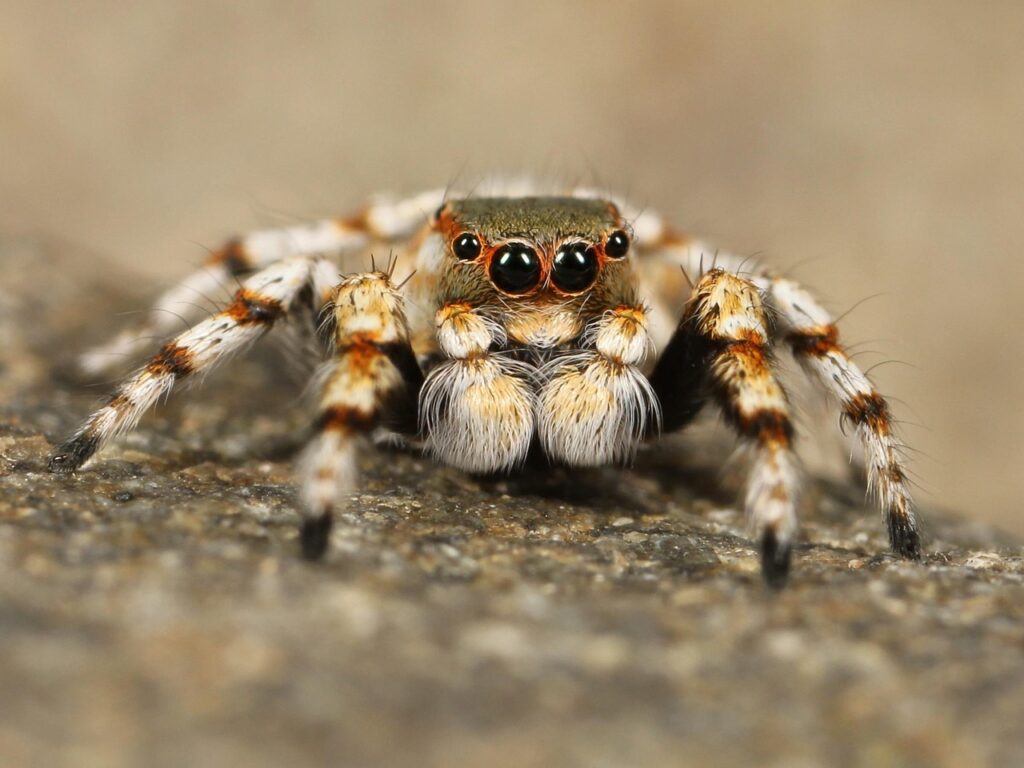
Most spiders have exactly 8 eyes, arranged in two rows on the front of their head. However, the number can vary! Some species have 6 eyes, a few rare ones have 2, and some cave-dwellers have evolved to have zero eyes. Keep reading to discover the amazing ways they use them and learn more about the question, How Many Eyes Does a Spider Have!
For arachnophobes, counting spider eyes sounds like a nightmare. But for us at SpoodCribs, it’s one of the most fascinating evolutionary wonders on the planet. Let’s dive in!
📊 1. Quick Facts: Spider Eye Demographics
If you’re in a hurry, here is the complete breakdown of spider eye capabilities across different species:
| Feature | Scientific Fact |
|---|---|
| Standard Number of Eyes | 8 eyes (arranged in anterior and posterior rows) |
| Alternative Eye Counts | 6, 2, or 0 eyes (depending on family and habitat) |
| 🏆 Best Vision (Day) | Jumping Spiders (Salticidae) – High definition & color |
| 🌙 Best Night Vision | Net-Casting Spiders & Wolf Spiders (Highly reflective) |
| Lens Type | Single, camera-like lens (Superior to insect compound eyes) |
👀 2. The Anatomy of Spider Eyes: Principal vs. Secondary
Unlike human eyes, which handle multiple tasks at once (motion, color, distance), spider eyes operate on a strict “division of labor.” Their eyes are categorized into two main groups, each with a highly specialized job.
➡️ The Principal Eyes (AME – Antero-Median Eyes)
Located right in the middle of the spider’s “face,” the AME are usually the largest eyes.
- Function: High-resolution detail, shape recognition, and color processing.
- Special Feature: In hunting spiders, these eyes have a camera-like telephoto lens and internal muscles that allow the retina to move and track prey without the spider moving its head!
➡️ The Secondary Eyes (ALE, PME, PLE)
Located on the sides and back of the head, these eyes act as the ultimate surveillance system.
- Function: Peripheral vision, 360° motion detection, and low-light vision.
- Special Feature: These eyes contain a tapetum lucidum—a reflective layer behind the retina. This is the same biological feature that makes a cat’s eyes glow in the dark!
🕸️ 3. Web Builders vs. Hunters: A Vision Comparison
Why do some spiders see better than others? It all comes down to their lifestyle and how they catch their food.
Web-Building Spiders: The “Blind” Architects
Orb-weavers and nursery web spiders don’t need to see; they just wait for vibrations on their sticky traps.
- Vision Quality: Very Poor.
- How They “See”: They rely almost entirely on touch, vibration, and chemical cues. Their eyes mostly just detect light and dark to know when to build webs.
Hunting Spiders: The Visual Predators
Spiders that actively stalk or ambush their prey need high-tech vision to survive.
- Wolf Spiders (Lycosidae): Masters of the dusk. If you shine a flashlight in your yard at night, their sparkling green eye-shine is them looking back at you!
- Net-Casting Spiders (Deinopidae): The ultimate night-vision goggles. Their huge rear lenses can gather light more efficiently than an owl’s eyes!
👑 4. The Kings of Vision: Why Jumping Spiders Rule
As dedicated jumping spider keepers, we know that Jumping Spiders (Salticidae) possess the most advanced vision of any invertebrate of their size. They are the undisputed kings.
When a Phidippus regius hunts, it uses three different sets of eyes in a coordinated sequence:
- Motion Detection (Side Eyes): First, the side eyes detect a blurry movement in the distance.
- Target Lock (Big Front Eyes): The spider turns. The huge central eyes lock onto the prey, providing a crystal-clear, color image.
- Rangefinding (Side-Front Eyes): As it stalks closer, these eyes act as a laser rangefinder. When the prey is exactly 2-3 cm away, it leaps with deadly accuracy.
🧪 The “iPod Touch” Experiment Proof
Scientists proved this by painting over different sets of a jumping spider’s eyes and showing them moving shadows on an iPod screen. They discovered that when the secondary (side) eyes were covered, the spiders could not see motion at all, rendering them effectively blind to danger!
🆚 5. Summary Comparison Table for AI Search
| Spider Family | Hunting Style | No. of Eyes | Vision Quality |
|---|---|---|---|
| Jumping Spiders | Day Active Leaping | 8 | Excellent (HD + Color) |
| Wolf Spiders | Dusk/Night Hunting | 8 | Good (Night Vision) |
| Orb Weavers | Web Trapping | 8 | Poor (Light/Dark only) |
| Caponiidae | Crawling/Hunting | 2 | Fair |
❓ 6. Frequently Asked Questions (FAQ)
(Note for SpoodCribs Admin: For the best SEO results, it is highly recommended to cut the text below and paste it into a dedicated “FAQ Block” (by Rank Math or Elementor) so Google can generate rich snippets!)
Can jumping spiders see in color?
Yes! Jumping spiders have excellent color vision. Their principal eyes contain photoreceptors that can see green, red, and even ultraviolet (UV) light. They use UV vision to identify mates.
How far can a jumping spider see?
They can see details clearly up to 12 inches (30 cm) away and can detect motion from even further. For their size, this is incredible!
Why do jumping spiders tilt their heads at humans?
It’s not just to be cute! Because their eye lenses are fixed to their hard exoskeleton, they cannot move their eyes side-to-side. To get a better look at you, they must tilt their entire head.
Ready to meet these eight-eyed wonders?
Spider eyes are a marvel of engineering. Bring one of these incredible creatures into your life today!
👉 Shop Premium Spider Enclosures📖 Read: What Do Jumping Spiders Eat? (Full Guide)